Buying Guides
How to Choose a Commercial Ultrasonic Cleaner
Capacity, heating and degas decide whether a commercial ultrasonic cleaner fits your work. This guide explains how to size the tank, match features to the job, and check compliance before you buy.
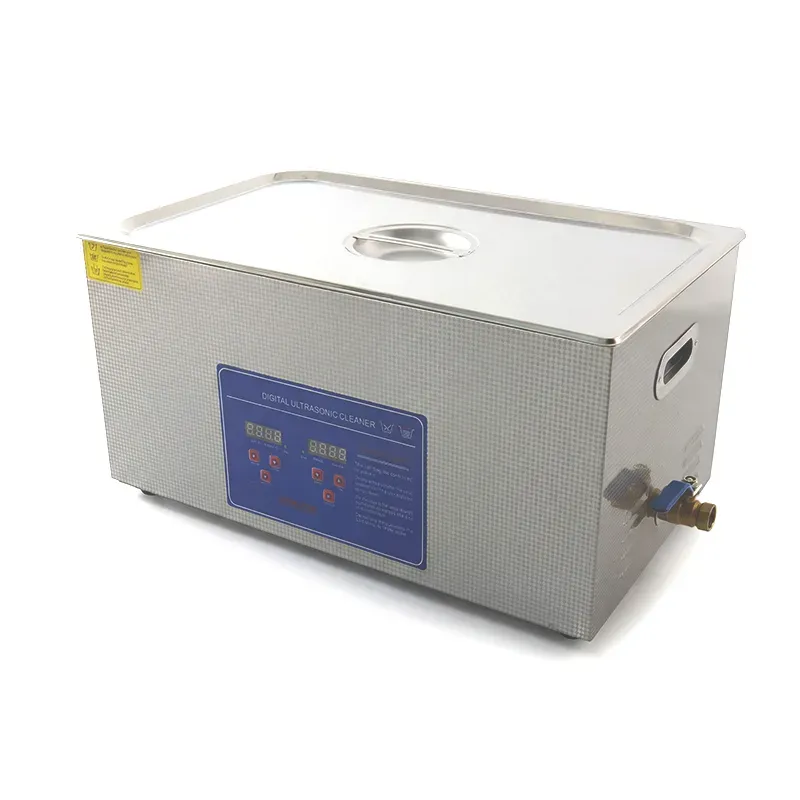
Size the tank to the largest item you clean, choose heating when you clean oily parts every day, and choose degas when you clean precision items with fine detail. That is the short answer, and the rest of this guide explains how to apply it without overbuying.
A tank that is too small leaves parts half-submerged and forces you to clean in batches, a tank that is far too large wastes cleaning solution and bench space, and a cleaner without the right features forces you to repeat cycles that should have finished in one pass. Match the machine to the work you actually do, not to the largest number printed on the specification sheet, and you will spend less time re-cleaning and less money on solution.
What Goes Wrong When the Size Is Wrong
The most common buying mistake is choosing by the headline number alone. A buyer sees a large nominal capacity, assumes every item will fit, and only discovers the problem on the first working day, when the basket sits too high, the liquid line falls below the rim of the tallest part, and the top edge of the load comes out still dirty. The cleaner is not faulty; the tank was simply bought for a number rather than for the parts it has to hold.
The second mistake is the mirror image: buying far more capacity than the work needs. A large tank takes longer to fill, uses more solution per change, and takes up bench space that a smaller unit would have left free, while the parts inside rattle around in a bath sized for something twice their size. Both mistakes cost the same thing, which is time, and both are easy to avoid once you know which figures on the specification sheet actually matter.
How to Read the Specification
Rated Volume and Working Volume
The capacity printed on the box is the nominal volume of the tank, measured to the brim. The working volume is lower, because the liquid must stay below the rim and the parts themselves take up space, and the level that matters in daily use is the waterline marked inside the tank. Two cleaners with the same nominal capacity can therefore hold different loads, and the only fair comparison is the working volume at the waterline with a basket in place.
Before you compare models, measure the largest item you clean, add clearance around it so the solution can circulate, and check that size against the internal dimensions of the tank rather than the headline litres. If the item only just fits, the cleaning will be uneven at the edges, and if it does not fit at all, no amount of extra power will make up the difference. Capacity is a question of geometry first and litres second.
Power and Tank Size
Ultrasonic power has to suit the size of the tank it serves. A small tank driven too hard can be rough on delicate parts, while a large tank with too little power will clean strongly in one corner and weakly in another, leaving the operator to move parts around between cycles. Ask how the power is distributed across the tank and whether the output stays even across the full working area, and treat any claim that a single figure describes cleaning performance as a sign to look more closely at the tank dimensions instead.
Heating and Oily Soil
Oil and grease come off slowly in cold solution, so a cleaner without heating will need longer cycles and more repetitions for engine parts, workshop tools, and any component that arrives coated in cutting fluid or road film. A heater warms the solution so the cleaning agent can work on the soil instead of fighting the temperature, and an adjustable heater lets the operator set a lower temperature for delicate work and a higher one for stubborn grease. If your daily load is mostly oily, heating is not an extra; it is the feature that decides how many cycles the job takes.
Loading the Basket
How parts are loaded matters as much as the machine itself. Pieces should sit in a basket with space between them, never piled on top of each other, because surfaces that touch each other do not get cleaned and delicate items can be marked by contact during the cycle. The basket should keep parts below the waterline while letting solution flow freely, and the load should be spread evenly across the tank rather than crowded into one corner, which is the simplest way to get an even result from any cleaner.
Choosing by Industry
Dental Clinics and Laboratories
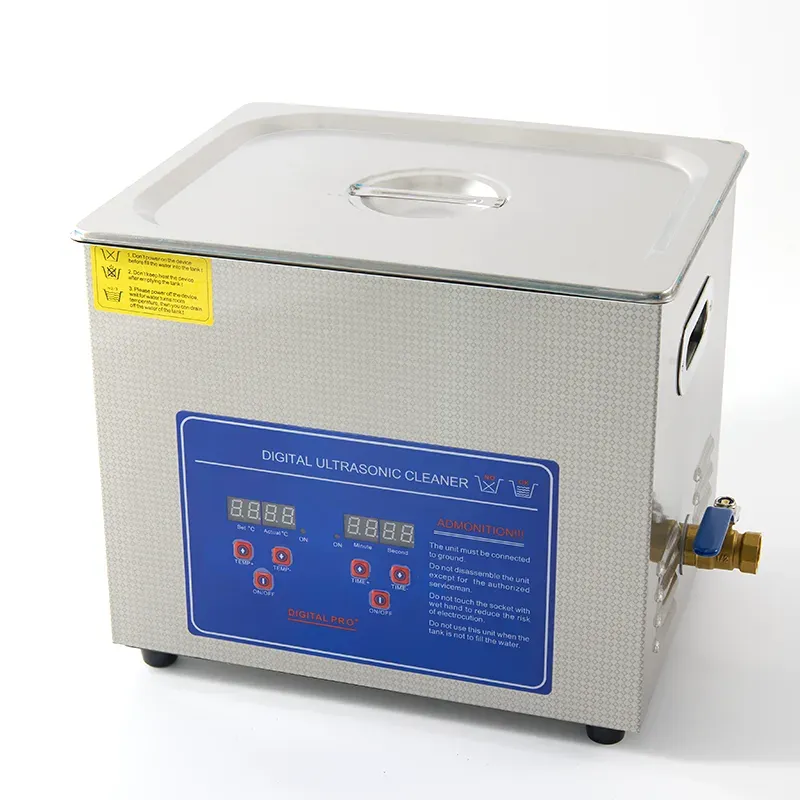
Dental clinics and laboratories usually clean small items: instruments, small tools, glassware, and components that fit comfortably in a small to medium tank. For this work, a compact tank with precise digital control of temperature and time is the right starting point, and the degas function earns its place because it removes trapped air from the solution and helps the cleaning reach fine joints, hinges, and blind holes. A drain valve matters here too, since solution is changed often between different types of work, and a one-piece drawn tank with no welds is easier to keep clean and resists corrosion from the solutions used every day.
Jewellery and Eyewear Stores
Jewellery and eyewear counters clean rings, chains, watch parts, and frames, all of them small, detailed, and easy to damage if they are handled roughly. A small to medium tank is usually enough, and degas is the feature to prioritise, because the value of the clean is in the fine detail: settings, links, and engraved surfaces that a bath full of tiny air bubbles cannot reach. Gentle handling matters as much as the machine itself, so a basket that keeps pieces separated and a heater that can be set low for everyday grime will serve a retail counter better than a larger tank bought for capacity alone.
Automotive and Parts Cleaning
Automotive and general parts cleaning is the opposite end of the range: brackets, housings, filters, and assemblies that are larger, heavier, and coated in oil and carbon. Here a large tank is justified, because the part must sit fully below the waterline with room for the solution to move around it, and heating is essential for cutting through grease in a reasonable cycle time. A drain valve becomes a daily convenience rather than a detail, since the solution is changed often, and the tank should be built to take hard use, which is where a one-piece drawn stainless tank with no welds proves its worth.
Checks Before You Order
Before you order, check the certifications your market requires and confirm that the model you are buying carries them. The marks most often asked for are CE, FCC, RoHS, UKCA, PSE, and UL, and different markets ask for different combinations, so confirm the set that applies to your destination rather than assuming one mark covers every region. A supplier should be able to state plainly which certifications apply to the model you are buying, and that answer belongs in writing before the order is placed.
Confirm the plug and voltage configuration for the country where the cleaner will be used. A unit wired for one market will not simply work in another, and an adapter is not a substitute for the correct plug and voltage rating, so state the destination country when you enquire and ask the supplier to confirm the configuration that will be shipped. This is a small check that prevents the most frustrating kind of delay, which is a machine that arrives and cannot be switched on.
Finally, validate with a sample before committing to volume. A sample lets you run your own parts, your own soil, and your own cycle time, and it turns every claim in this guide into a result you have seen with your own eyes. Pay attention to whether the parts come out clean in a single cycle, whether delicate items survive the process, and whether the tank size genuinely fits the largest piece you clean, and treat the answers as the real specification, whatever the brochure says.
Your Next Step
Work through the checks in this guide in order: measure your largest item, compare it with the working volume at the waterline, decide whether heating and degas match your daily soil and your finest detail, confirm the certifications and the plug and voltage for your market, and run a sample with your own parts. If you would like help turning those answers into a model choice, send an enquiry with the size of your largest item, the type of soil you clean, and your destination country, and ask for selection advice together with the full specification sheet. To send that enquiry, use the form on this website. Mob / WhatsApp / WeChat: +86 15920036975.