If you are asking what size ultrasonic cleaner do I need, you are asking the most useful question in the whole buying process, because capacity decides whether a part can be cleaned at all, how evenly it is cleaned, and how many pieces you can finish in one cycle. A cleaner that is too small forces you to clean large parts in stages, or to leave part of a part above the liquid, and that defeats the purpose of ultrasonic cleaning. A cleaner that is far too large wastes bench space, liquid and heating time. This guide explains how to judge capacity by internal tank dimensions rather than by the headline litre number, and how to match common sizes from 1.3L to 50L to real work.
Why the Litre Number Alone Can Mislead You
A litre figure describes how much liquid a tank can hold, not how much working space it offers. Two tanks can both be labelled 10L and still differ in length, width and depth, and those three dimensions decide which parts fit. A long, shallow tank suits long tools and flat plates. A deep, narrow tank suits tall bottles and upright instruments. Before you compare litre numbers, compare the internal tank dimensions published on the product page, and measure your largest part in all three directions. If the part does not fit with room to spare, the litre number on the box will not help you.
That is why the tank size, given as length by width by depth, is the figure to check first. A 10L model with a tank of 300 × 235 × 150 mm, for example, gives you a clear working area of 300 mm by 235 mm and a usable depth of 150 mm, and any part longer than 300 mm in any direction will not fit flat, however the litre number reads. The basket that holds the parts takes up space as well, and the liquid level must stay below the rim, so the real working space is always a little smaller than the bare tank dimensions. When two models carry the same litre label, the one whose tank matches the shape of your parts is the better choice, even if the other one looks larger on paper.
How to Fit a Part: Full Immersion and Clearance
Ultrasonic cleaning works only where the cleaning liquid reaches the surface, so a part must be fully immersed before the cycle starts. If an edge or a corner stays above the liquid, that area is simply not cleaned, and turning the part over halfway through is a poor substitute for a tank that fits it in one go. Measure the part at its longest, widest and tallest points, including handles, brackets and any fittings that stick out, and compare those figures with the tank dimensions. A part that fits only diagonally, or only with the lid forced down, is a sign that the tank is too small for that job.
Leave a gap between the part and the tank walls, and between the part and the tank floor. Parts should rest in the basket, not directly on the tank floor, because direct contact can mark the surface and can block the sound waves where the part touches the metal. A gap also lets the liquid circulate around the part and lets loosened soil move away from the surface instead of settling back on it. As a working habit, aim for a finger-width of space on each side of the part, and do not stack parts on top of one another. A single layer in the basket cleans more evenly than a piled load, and it avoids the small scratches that parts cause when they vibrate against each other.
Home Use: From 148 ml to 1 L
At home, the parts are small and the jobs are light, so the smallest cleaners are often the right choice. A compact cleaner of a few hundred millilitres takes care of glasses, rings, earrings and other small jewellery, and it sits neatly on a desk or a bathroom shelf without taking over the room. A capacity around 148 ml suits a single pair of glasses or a few small pieces at a time, while a 600 ml to 1 L tank gives you room for a larger pair of glasses, a watch bracelet or several pieces of jewellery in one cycle, and for removable aligners and retainers that need a daily clean.
Home models are usually simple to run: fill the tank with water, add a small amount of a suitable cleaning solution where the instructions allow it, place the items in the basket, and run a short cycle. Most small home cleaners have no heater, and they rely on the ultrasonic action, the cleaning solution and the cycle time instead. That is enough for the light soil found on personal items, such as skin oils, dust and toothpaste residue on aligners. Keep the items in a single layer, keep metal parts from knocking against each other, and dry them after the cycle, and a small cleaner will handle daily home use for a long time.
Commercial Sizes: 1.3 L to 50 L at a Glance
Commercial work brings larger parts, heavier soil and more pieces per day, and the digital range covers that spread in steps from 1.3 L to 50 L. Small commercial tanks of 1.3 L, 2 L and 3 L suit dental instruments, laboratory glassware and small precision parts, where the load is light but the cleaning standard is high. The 2 L to 3 L sizes are a common choice for dental instrument cleaning, because a full set of hand instruments fits in one load with room for the liquid to circulate, and the digital timer and temperature control keep each cycle repeatable.
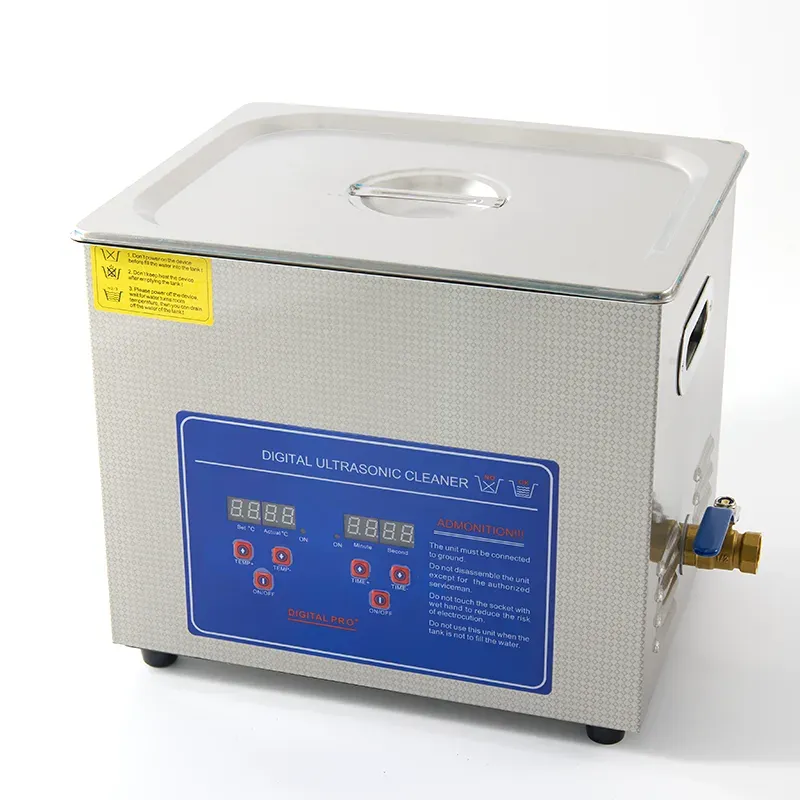
Mid-range tanks take on workshop soil. A 4.5 L or 6 L tank suits carburettors, fuel injectors and small engine parts, where a heater helps to soften grease and oil before the ultrasonic action lifts it away. A 10L digital ultrasonic cleaner with a tank of 300 × 235 × 150 mm suits general workshop parts, larger tool sets and batches of smaller components, and it is a practical step up when a 6 L tank starts to feel crowded. Tanks of 15 L and 22 L take larger batches and longer parts, while a 30 L tank with an internal size of 500 × 300 × 200 mm suits large single parts and full batches that would need several cycles in a smaller machine.
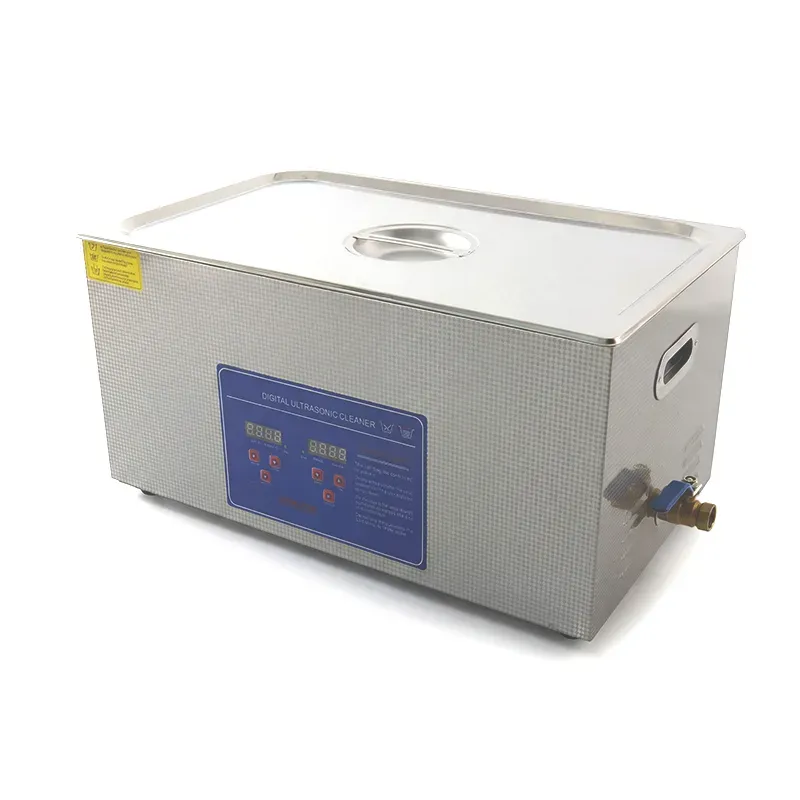
At the top of the range, a 50L digital ultrasonic cleaner is built for large parts and high-volume batch work, such as engine and gearbox parts, large moulds and heavy workshop components. Its deep tank and casters suit a fixed place in the workshop, and the basket keeps large parts off the tank floor. To compare the whole commercial range in one place, browse the commercial ultrasonic cleaners collection and check the tank dimensions of each size against the largest part you need to clean.
Two Rules Before You Order
First, when two sizes both seem to fit, choose the larger one. A tank that is slightly too large costs a little more bench space and liquid, while a tank that is slightly too small costs you a second cycle for every oversized part, or forces you to leave parts partly out of the liquid. If your largest part only just fits, remember that the basket, the liquid level and the clearance you need all take space, so a comfortable fit today leaves room for the slightly larger part that arrives tomorrow. Buying a little extra capacity is the cheapest insurance in ultrasonic cleaning.
Second, match the heating power to the tank. A larger tank holds more liquid, and more liquid takes longer to warm up and needs more heating power to hold a working temperature through a full load. Check the heating power and the maximum temperature on the product page, and think about the soil you need to remove: light dust and fingerprints need little heat, while grease, oil and dried deposits benefit from a warm tank and a suitable cleaning solution. A small tank with a strong heater and a large tank with a weak heater will both disappoint you in different ways, so read the heater specification next to the tank dimensions before you decide.
Conclusion: Start With the Part, Not the Litre Number
Choosing a size is a measurement job, not a guessing game. Start with the largest part you need to clean, check it against the internal tank dimensions, and make sure it can sit fully immersed with a gap on every side. Then match the size to the work: a compact tank for glasses and jewellery at home, a 2 L to 3 L tank for dental instruments, a 6 L tank for a carburettor, a 10 L tank for general workshop parts, and a 30 L or 50 L tank for large parts and batch work. Buy a little larger than your biggest part, and match the heating power to the tank, and the cleaner you choose will do the job in one cycle instead of two.
Planning a purchase for your business? Send an inquiry through the form on this page and we will recommend the right model with full specifications and a quotation. Mob / WhatsApp / WeChat: +86 15920036975. Private label and OEM are available from 300 units.