Ultrasonic Jewelry Cleaner Liquid: What Actually Works
Water alone cleans more than you'd expect. When jewelry cleaner liquid earns its place, what to use, and the stones that should never meet it.
-
Stand in front of the cleaning aisle — or scroll the listings — and "ultrasonic jewelry cleaner liquid" looks like a product category you are supposed to buy into: concentrates, brighteners, brand-name bottles. Searches for it are up about 150% in a year. Here is the part the bottles do not print: for most jewellery, most of the time, the liquid that works is water. The honest question is narrower — when does a cleaning liquid actually earn its place in the tank, what should it be, and which pieces should never meet either the liquid or the machine at all?
What plain water already does
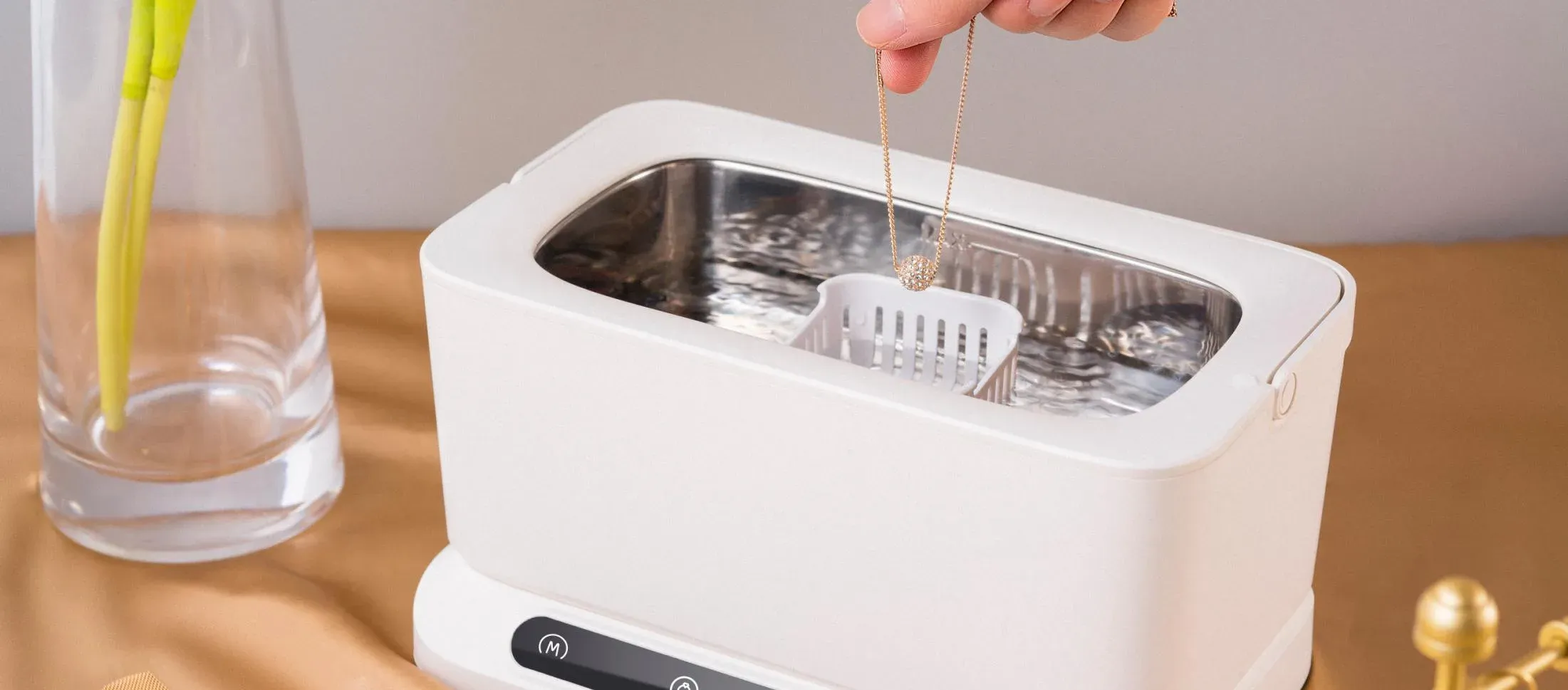
An ultrasonic cleaner does not clean with its liquid; it cleans with cavitation — microscopic bubbles collapsing against the surface and stripping soil mechanically. Water is the medium that carries those bubbles, and for the everyday film on jewellery — skin oil, soap residue, dust, lotion — plain water at 45–50 kHz for three to five minutes removes the lot. If your rings come out bright from water alone, no bottle will make them brighter. Start there; it is also the only liquid that is safe for every stone on the safe list below.
When a liquid earns its place
A cleaning solution helps when the soil fights back. Surfactants lower the water's surface tension so cavitation reaches into chain links and under stone settings; degreasing agents cut the heavier oils from cosmetics and workshop handling; warmth multiplies both effects. Three situations justify reaching past plain water:
- Heavily worn everyday pieces: chains and bracelets carrying weeks of lotion and skin oil come up faster with a drop of mild washing-up liquid in the tank — the classic jeweller's bench trick, and all most home users ever need.
- Workshop pieces after polishing: polishing compound packed into settings is a degreasing job — a proper jewellery cleaning concentrate at its stated dilution, in a heated bench tank at 50–60 °C. This is the workflow in our jewellery workshop guide.
- A fresh, gassy fill: new solution releases dissolved gas that cushions cavitation; run the degas cycle (or a few empty minutes) before the first load — the physics is in our degas guide.
What to use, and what to keep out
Use, in order of strength: plain water; water with a drop of mild dish soap; a commercial jewellery ultrasonic concentrate diluted exactly as labelled. Many commercial formulas are ammonia-based — effective on gold and hard stones, but ammonia and strong detergents are a risk to soft and treated stones, and bleach, acids and solvents should never go in the tank at all: they attack metals, seals and the tank itself. Our full solution guide covers dosing by job. One more limit applies to every liquid on this page: solution removes dirt, not tarnish. The grey film on silver is oxide, a chemical layer — it needs a dip or a polishing cloth, and no ultrasonic liquid will lift it.
The stones that should not meet the machine
The liquid matters less than the guest list. Ultrasonic cleaning — with any liquid — is for hard, stable stones and solid metals: diamonds, rubies, sapphires, gold, platinum and silver come through beautifully. Keep these out entirely: pearls, opals, emeralds, turquoise, coral and amber. They are porous, fractured, oiled or glued, and cavitation can crack, dull or loosen them; clean them with a damp cloth instead. The full item-by-item list lives in our home jewellery guide. When a piece's value is sentimental or financial and you are unsure of the stone, the rule is simple: if you cannot identify it, do not immerse it.
The routine that makes liquid almost unnecessary
Weekly three-minute cycles in plain water keep film from ever becoming the crusted soil that needs chemistry. That is the quiet secret behind the liquid question: jewellery cleaned little and often barely needs a solution at all, in a 500 ml home unit like the SJ-W6 or at a workshop bench. Jewellery cleaned once a year needs the bottle, the heat and the patience. Choose which owner you are, and the liquid buys itself — or doesn't.
Ask us which setup matches your pieces
Tell us what you clean — a few home pieces, or a bench serving customers — and we will point to the right tank size and say plainly whether you need a solution at all. Home units run 400 ml–1 L; workshop tanks with heating run to 50 L, and private label starts at 300 units for retailers. Enquire through the contact page, or call or message us — Mob / WhatsApp / WeChat: +86 15920036975.